
A potato soil elevator transfer should be checked with crop carrying representative loose and adhering soil, not only with clean potatoes. Observe the discharge, landing zone and receiving flow together. Compare timed samples before and after the hand-off, track accumulation over the run, and agree acceptance criteria for continuity, spillage, crop condition and downstream presentation.
Key takeaways
- Test representative loose and adhering soil, not clean crop alone.
- Locate where accumulation starts before changing elevator operation.
- Trace impurity discharge separately from the potato stream.
- Accept a defined crop, soil and feed envelope using repeatable measurements.
Why a clean-crop transfer test is not enough
A potato transfer can look orderly during a short run with clean crop, then develop a growing pile when field soil arrives. Loose earth adds material to the stream; adhering soil changes how potatoes contact the transfer surfaces; clods may travel differently from the crop. The operating problem is therefore not simply whether the elevator moves potatoes. It is whether the discharge and receiving point remain clear while carrying the soil burden expected during production.
Inspect three locations together: the material approaching discharge, the landing zone, and the flow leaving the receiving point. A crowded landing zone may originate upstream, at the hand-off, or farther downstream. Record when the disturbance begins and where material first accumulates. This prevents a common commissioning mistake: changing the elevator setting to compensate for a receiving stage that is already overloaded. Clean-crop checks remain useful, but they cannot establish performance under dirty-crop conditions.
Define the actual soil elevator and lifter interfaces
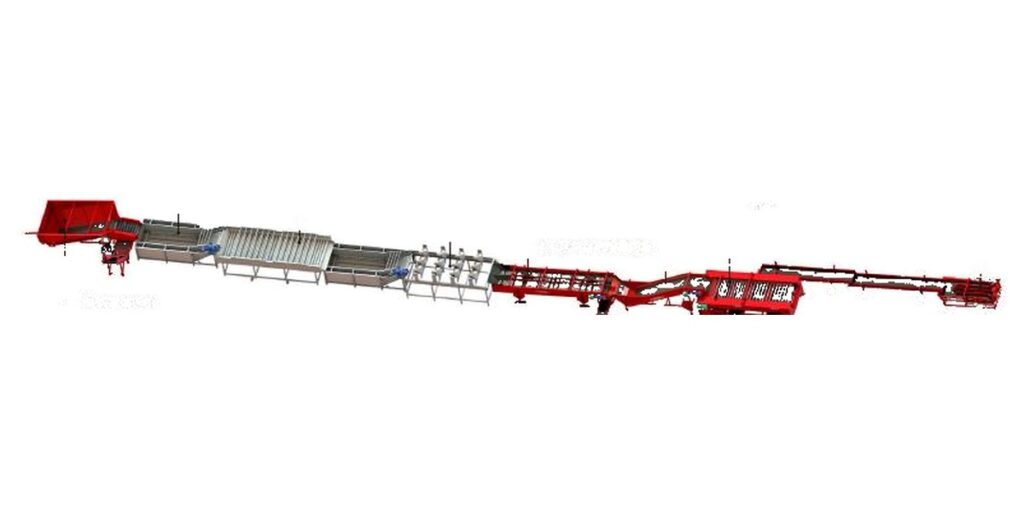
The Potato water-washing sorting solution includes a cleaning machine, soil elevator, bubble washer, brush rollers, manual selection platform, lifter, mechanical sorter, conveyor and bagging machine. Its line length is approximately 45 m. That description identifies process elements, but it does not establish the geometry of every junction. For this inspection, use the selected project arrangement to identify what the soil elevator actually receives and where its discharge goes.
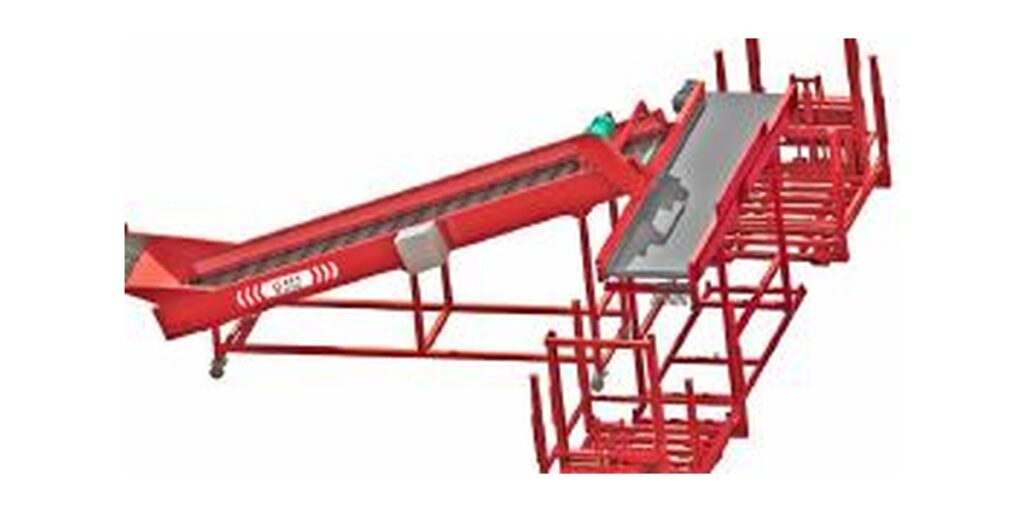
The Potato roller lifter uses stainless rollers to rotate and elevate potatoes in a single layer, helping maintain a stable feed to the sorting machine. It is a possible configured hand-off, not a documented component identity for the lifter in the washing solution. Confirm its proposed position, dimensions and installation clearances before evaluating that interface. Keep soil-elevator observations separate from later lifter observations unless the selected layout establishes a direct connection.
How soil changes the transfer mechanism
At a hand-off, material must leave one carrying surface, cross the intervening space and move away on the receiving surface. Loose soil can fall separately, while adhering soil can stay with the potatoes. Damp deposits may narrow an otherwise clear passage or alter the landing surface. These are possible mechanisms to investigate, not documented behavior of a particular machine. Look for the first deposit and its growth rather than assuming that every blockage has the same cause.
Distinguish a brief pile caused by an incoming surge from persistent accumulation caused by insufficient removal. A surge should diminish after the incoming flow falls; a persistent deposit remains or grows across comparable feed periods. Also distinguish material that is intentionally separated from material that spills outside its intended route. A successful inspection follows both potatoes and impurities. Watching only the crop outlet can hide soil collecting underneath or returning to the main stream.
Choose the cleaning duty before fixing the transfer duty
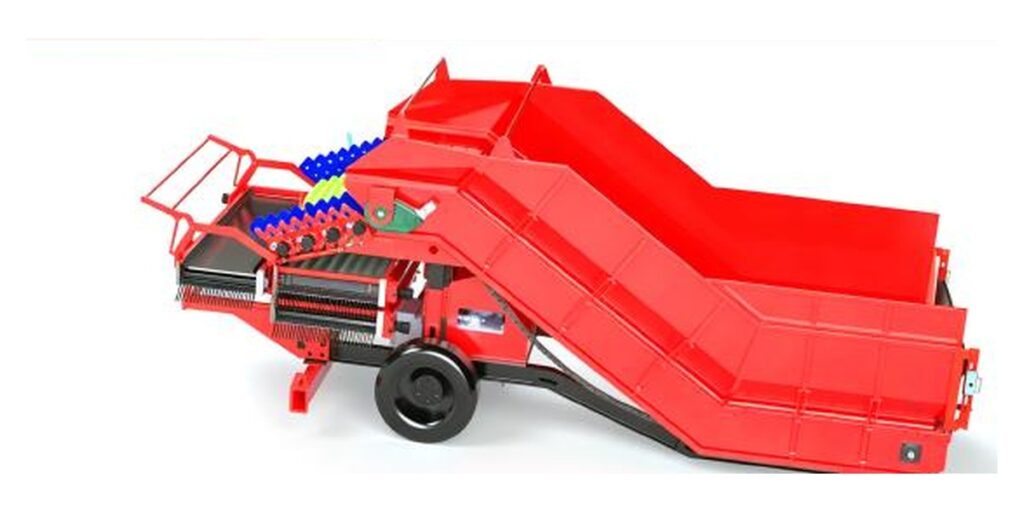
The Potato cleaning machine BQX-16 / BQX-20 / BQX-24 receives bulk potatoes and feeds a hydraulic cleaning roller. Soft PU spiral blades, adjustable roller spacing and a double-layer impurity conveyor support cleaning and separation. This upstream function matters because the material presented to a transfer is not necessarily identical to the incoming crop. Evaluate the actual outgoing stream rather than treating an intake capacity figure as a guarantee of downstream transfer capacity.
Configuration should account for crop flow, residual soil, occasional clods and the receiving process together. The complete washing line is configured to project requirements; its component and total line capacities require confirmation for the selected configuration. Use our potato processing solution planning information to frame the overall duty, then examine each hand-off individually. Where adjustment is available, changing cleaning conditions may change both impurity separation and crop presentation, so repeat the transfer observation after an upstream adjustment.
| Product | Verified process function | Verified sizing information | Meaning for the interface review |
|---|---|---|---|
| Potato water-washing sorting solution | Outbound washing, sorting, grading and bagging; includes a soil elevator and a lifter | Line length approximately 45 m; capacity configured to project requirements | Overall layout and component capacities are project-specific. |
| Potato roller lifter | Stainless rollers rotate and elevate potatoes in a single layer, helping maintain a stable feed to the sorting machine | Dimensions and installation clearances are confirmed with the line layout | Its lifting and presentation role does not establish a soil-elevator connection. |
| Potato cleaning machine BQX-16 / BQX-20 / BQX-24 | Bulk potato receiving, soil removal, impurity separation and warehouse intake | Capacity: 40 t/h / 60 t/h / >90 t/h | The listed cleaner capacities do not establish complete-line capacity. |
Inspect geometry before changing operating settings
Before running material, inspect the installed discharge position, receiving width, intervening gap and accessible deposition areas under the site’s isolation procedure. Compare them with the agreed arrangement. Identify ledges or corners where soil could collect, and establish how separated material leaves the area. Do not assign a universal acceptable drop height or gap: potato size distribution, trajectory and the receiving surface all influence the result. Geometry must be assessed against the crop and the selected equipment.
During the controlled trial, observe whether potatoes land centrally, strike an edge, rebound, roll backward or form overlapping layers. Use observation points that do not require reaching into moving equipment. Record crop condition before and after the transfer so damage already present at intake is not attributed automatically to the hand-off. If uneven presentation continues toward inspection or sorting, see our water-wash cleaning and lifting inspection guide for a separate downstream assessment.
Build a trial around representative soil conditions
Select trial lots that represent the intended operating range: relatively clean crop, crop with loose earth, and crop with adhering soil where those conditions occur. Include the expected size range and record visible clods, moisture condition and unusual debris. Do not add an arbitrary soil quantity and call it representative. Where practical, characterize each lot with weighed crop and separated-soil samples using the same collection method. State what the method excludes, such as soil still adhering to potatoes.
Begin at a controlled feed condition, then move toward the intended operating requirement within the agreed trial procedure. Observe long enough to reveal accumulation, rather than judging only the first material through. Collect timed samples at accessible points before and after the hand-off and record stoppages, spills and setting changes. For a hypothetical comparison, two lots with similar potato flow but different adhering-soil conditions may reveal deposit growth that a clean lot misses. That comparison is informative only when the other trial conditions remain comparable.
Use the timing of each symptom to isolate its cause
When a problem appears, keep the observation anchored to its first location and timing. An upstream pulse followed by a temporary landing pile points toward feed variability. A deposit that grows during steady feeding suggests a local retention or removal problem. A clear landing zone followed by congestion farther along suggests receiving-stage restriction. These are diagnostic hypotheses, not proof. Compare observations across trial lots and inspect the stopped, isolated equipment before deciding which explanation fits.
Change one relevant variable at a time where the equipment permits adjustment. Record the original condition, the change and the resulting behavior at the same observation points. Avoid simultaneously changing upstream separation, elevator operation and downstream feeding: an apparent improvement would then be difficult to explain or reproduce. If a change only moves soil accumulation elsewhere, the interface has not been resolved. Review the complete impurity route alongside the potato route before accepting the new setting.
| Observed symptom | Working hypothesis | Comparison or inspection | Decision evidence |
|---|---|---|---|
| Landing pile appears after an incoming pulse, then clears | Feed variability exceeds temporary receiving ability | Compare incoming-flow timing with pile formation and clearance | Whether comparable pulses repeatedly produce the same response |
| Soil deposit grows during apparently steady feeding | Local retention or inadequate impurity removal | Inspect the first deposit location after isolation; compare soil conditions | Deposit growth over a recorded interval and its material composition |
| Potatoes repeatedly strike one receiving edge | Discharge alignment or trajectory mismatch | Compare installed geometry with the arrangement and observe landing distribution | Repeatable landing pattern across representative crop sizes |
| Landing zone stays clear but downstream material backs up | Restriction farther into the receiving stage | Locate the first persistent congestion point | Whether the restriction begins downstream before reaching the hand-off |
| A change clears the crop path but creates soil buildup elsewhere | Impurity route remains unresolved | Trace separated material through its intended discharge route | No continuing accumulation at the new location during the repeated trial |
Accept the hand-off within a stated operating envelope
Agree acceptance criteria before the trial. Useful categories include sustained transfer at the specified project feed, accumulation over a defined run period, unintended spillage, crop condition changes and presentation to the receiving stage. Give each category a measurement method and an agreed limit; do not substitute a subjective statement such as ‘runs smoothly.’ Record the sampling locations, sample sizes, trial duration and whether feed figures describe potatoes alone or potatoes plus accompanying soil.
The acceptance record should identify the crop lots, soil conditions, configuration and settings actually tested. State any operating condition outside that envelope, such as a wetter lot that was not available during commissioning. A successful transfer trial does not establish total washing, grading or bagging capacity, and it does not prove performance for every harvest condition. We use the interface result to support a defined project decision: accept the tested arrangement, revise it, or conduct a further targeted trial.
Plan a representative soil-loaded transfer trial
Discuss your potato transfer arrangement with our engineering team. Send representative crop samples, potato size range, loose and adhering soil conditions, target potato flow, expected feed surges, discharge and receiving elevations, available layout, water and utility requirements, and your proposed trial duration and acceptance limits.
- The water-washing sorting solution has a line length of approximately 45 m.
- Water supply, utilities, layout and final capacity are configured for each project; component and total line capacities are confirmed for the selected configuration.
- The roller lifter uses stainless rollers to rotate and elevate potatoes in a single layer, helping maintain a stable feed to the sorting machine.
- BQX-16 / BQX-20 / BQX-24 capacities are 40 t/h / 60 t/h / >90 t/h.
Frequently asked questions
Can we accept the soil elevator after testing only clean potatoes?
A clean-potato run can check basic movement and reveal obvious alignment problems, but it cannot establish transfer performance under representative soil load. Include crop with the loose and adhering soil expected in production. Observe deposit growth and impurity discharge as well as potato movement, and state the conditions covered by acceptance.
Is the roller lifter the documented lifter in the water-washing solution?
The solution names a lifter but does not establish that it is the roller lifter. Treat the roller lifter as a possible configured option requiring layout confirmation. Its documented role is to rotate and elevate potatoes in a single layer, helping maintain stable feed to the sorting machine.
Does the cleaning machine capacity determine the washing line capacity?
No. The cleaning machine capacities apply to the listed cleaning models, not automatically to the soil elevator, receiving equipment or complete washing line. The washing solution is configured to project requirements. Confirm component and total line capacities for the selected arrangement, then test the relevant interfaces with representative crop and soil.
How can we distinguish a feed surge from a transfer blockage?
Compare the timing of incoming flow with material accumulation. A pile that follows a pulse and then clears suggests temporary feed variability. Accumulation that persists or grows during comparable steady feeding suggests a retention or removal problem. These observations guide investigation; inspect the isolated equipment and repeat a controlled comparison before concluding.
What should the transfer acceptance report contain?
Record crop size range, soil and moisture conditions, trial duration, sampling locations, feed measurement basis, configuration and settings. Include accumulation, unintended spillage, crop condition and receiving-stage presentation results against agreed limits. Identify untested conditions explicitly so acceptance describes the demonstrated operating envelope rather than implying performance across every possible harvest condition.
Engineering note
Transfer behavior depends on crop size, loose and adhering soil, moisture, feed variability and the installed receiving arrangement. Project acceptance should use agreed sampling methods and limits, with results tied to the configuration and material conditions actually tested.
 English
 Chinese
 Spanish
 German
 French
 Russian
 Urdu
 Bengali
 Kazakh
 Ukrainian
 Dutch
 Polish