
Control potato harvest receiving peaks by scheduling unloading against the available onward flow, providing defined temporary holding and allowing that holding to clear before the next burst. BCCD-611 serves bulk retrieval and transfer; BDDY-818 serves bulk stacking and loading. Select each by its process duty, then test the complete receiving, lifting and destination sequence under repeated arrivals.
Key takeaways
- Separate arrival bursts from temporary holding, warehouse capacity, retrieval and loading duty.
- Choose the functional role first, then check capacity, footprint, movement range and control method.
- Test both buffer filling and recovery under the planned repeated-load condition.
- Accept the arrangement against a written flow sequence and destination test.
Why Harvest Peaks Overload Receiving Lines
Harvest receiving peaks are a timing problem before they are a machine-sizing problem. Several loads can arrive together while lifting, storage placement or loading proceeds more slowly. Control the burst by scheduling unloading, defining temporary holding and testing the onward route—not by selecting the largest component rating.
Record both the quantity arriving and the interval between loads. A seasonal average hides short overloads. Build an arrival schedule showing when each load reaches the site, when unloading starts and when it finishes. Distinguish vehicles waiting to unload from potatoes already occupying temporary holding: they require different operating decisions. Compare the schedule with periods when the onward destination is available, including planned changes between storage areas or loading duties. The potato cleaning intake sizing guide helps frame the upstream flow requirement; here, the decision is how to manage arrivals when the next stage cannot immediately accept them.
- Record the highest expected receiving burst, not only the seasonal average.
- Define whether the buffer is temporary holding or part of warehouse capacity.
- Map every transfer between arrival, storage, retrieval and dispatch.
Separate Buffer, Storage and Dispatch Duties
Temporary holding absorbs a timing difference; warehouse capacity describes how much material the storage arrangement can accommodate. Define the usable holding quantity separately from the transfer rate. Start with the quantity already present before the burst, because occupied holding space is unavailable to the next load. If the site describes holding in cubic metres, establish a suitable basis for converting that volume to tonnes before comparing it with flow in tonnes per hour. BCCD-611 is bulk retrieval and transfer conveying equipment, not a vessel with a stated holding volume.
For a hypothetical burst, assume arrivals of 50 t/h and onward transfer of 35 t/h for 20 minutes, with no other flows. Accumulation is (50 − 35) × 20/60 = 5 tonnes. If arrivals then stop and outgoing flow remains 35 t/h, those 5 tonnes take about 8.6 minutes to clear. Drawdown uses the outgoing rate, not the earlier 15 t/h difference.
- State the intended holding duration or operating purpose of each buffer.
- Distinguish storage volume from the rate at which material can be retrieved.
- Identify where a full storage area sends the incoming flow.
Choose the Function Before the Machine
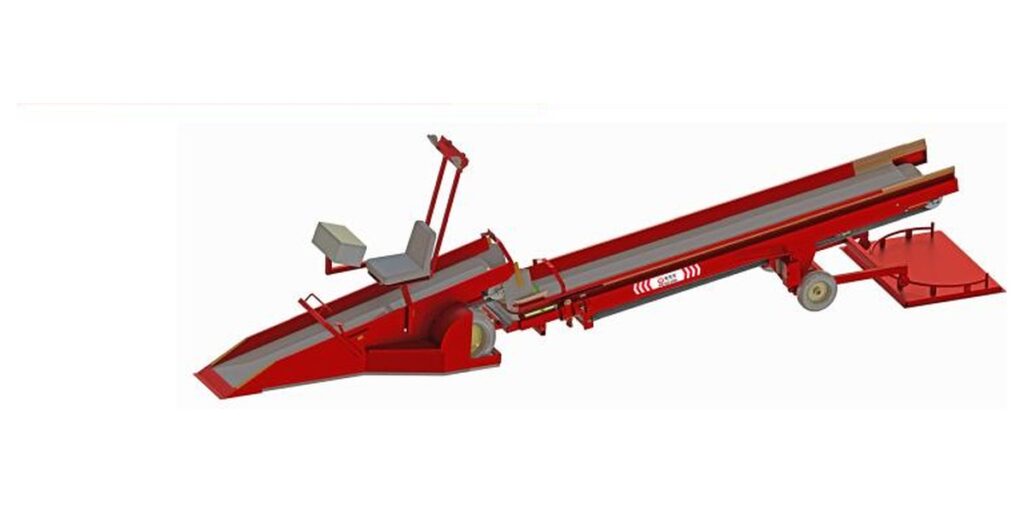
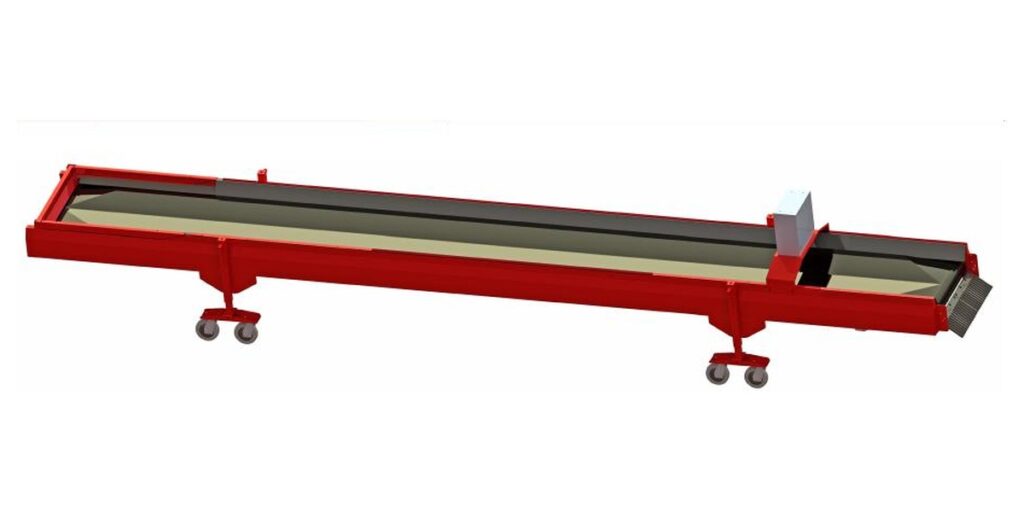
Choose BCCD-611 bulk retrieval and transfer equipment when the task is moving potatoes from storage into the next route. Its discharge position is adjustable without changing the storage line, and a flexible buffer plate reduces impact at the outlet. That plate is not a holding vessel.
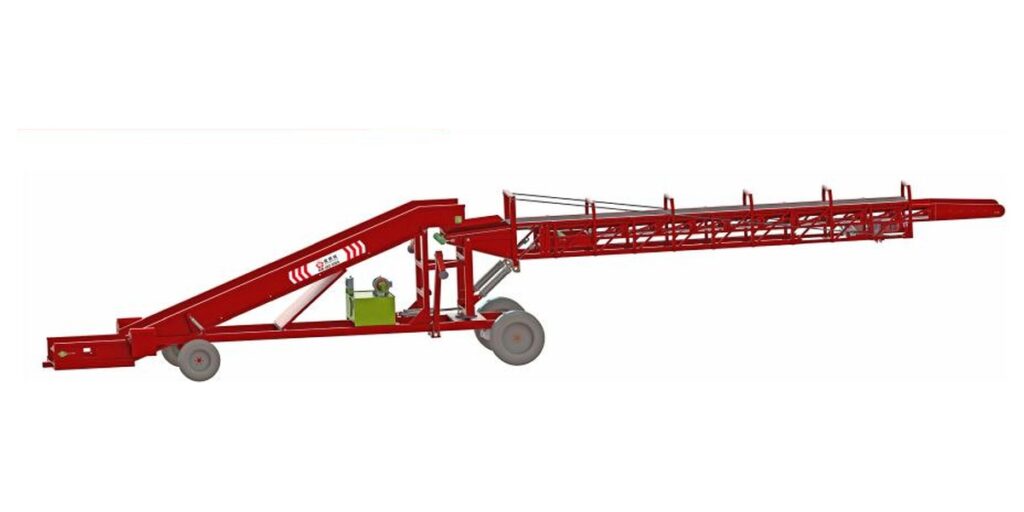
Choose BDDY-818 bulk stacking and loading equipment when loose potatoes must be placed or loaded. Its telescopic conveyor and harvesting-chain lifting section serve bulk handling; it offers manual remote or control-box operation. Assess where the conveyor must deliver material and how operators will reposition it as the destination changes. If the project includes filled ton-bags, define their movement and storage arrangements as a separate handling duty.
Interpret Capacity Without Treating It as a Line Guarantee
BCCD-611 has a nominal rating of approximately 60 t/h; BDDY-818 has approximately 80 t/h. These describe separate machines, not a combined 140 t/h receiving line. A restricted transfer, occupied destination or slower lifting stage can limit the configured system even when each component appears sufficient.
Use dimensions and movement ranges to screen the layout, then test the material path. Nameplate power is 6.6 kW for BCCD-611 and 15.25 kW for BDDY-818; these are not energy-consumption figures in kWh or forecasts of operating cost. A larger rating alone does not solve peak timing.
- Compare nominal machine ratings with the duty each machine must perform.
- Check footprint, extension range and discharge movement against the site route.
- Establish configured-line capacity through project design and a site flow test.
| Required duty | Equipment option | Selection boundary |
|---|---|---|
| Cleaning, picking, lifting and ton-bag intake | Ton-bag receiving and storage line; reversible conveying and hydraulic buffer filling | Project-specific capacity; define filling and recovery sequence. |
| Bulk retrieval and transfer | BCCD-611; approximately 60 t/h; adjustable discharge | Not a holding vessel; check storage interface and discharge reach. |
| Bulk stacking and loading | BDDY-818; approximately 80 t/h; telescopic conveyor | Handles loose potatoes, not lifting filled bags or pallets. |
Configure the Receiving Sequence Around the Peak
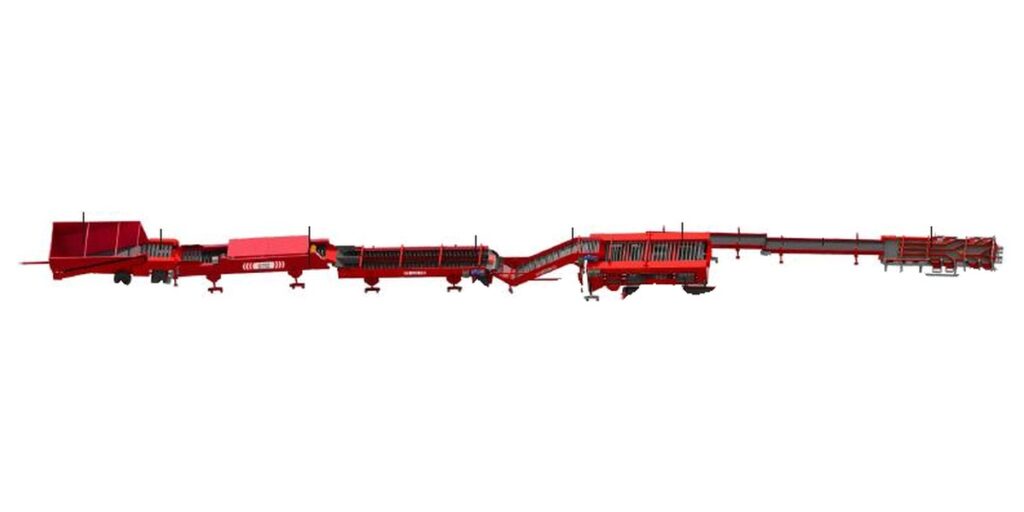
Sketch the sequence from unloading through cleaning, picking, lifting and the chosen destination. The ton-bag receiving and storage line combines these intake duties with reversible conveying and hydraulic buffer filling. Its capacity is configured to project requirements; component ratings cannot establish its output.
Check how the lifting stage hands material to the next conveyor and what happens when that destination becomes unavailable. Reversible conveying supports continuous bag filling in this line, but the project must still define the filling sequence and handling of completed bags. BDDY-818 does not provide bag lifting.
Place the equipment on a site drawing. BCCD-611 has a conveying length of 7900 mm contracted and 11000 mm extended, with a 120° rotation angle. Check discharge reach and access against those limits. Define who pauses unloading or redirects flow when the planned holding area reaches its usable limit.
Run a Site Flow Test Before Acceptance
Agree on representative material, arrival timing, target flow, trial duration and destination before acceptance. Include crop condition and storage occupancy in the trial log. Use the potato conveying and sorting commissioning checklist to organize checks before running the agreed sequence.
Following the site’s commissioning procedure, check empty operation before introducing material at a controlled rate. Observe every hand-off, especially the lifting discharge and destination conveyor. Log transferred quantities and elapsed time so measured flow has clear units rather than relying on visual impressions. Measure incoming and outgoing quantities over matching intervals, and record the holding quantity at the start and end. This makes the trial’s mass balance interpretable: the change in holding equals incoming mass minus outgoing mass, with any material diverted elsewhere recorded separately.
Test both filling and recovery of any temporary holding area. Then repeat closely spaced arrivals with the restrictive planned destination condition. One uninterrupted load cannot demonstrate recovery between bursts. Record whether holding returns to its agreed starting level before the next arrival, or whether residual material accumulates from one burst to the next. If the destination must change during normal operation, include that change in the agreed trial sequence and log the resulting pause. Agree on stop conditions and acceptance criteria in advance rather than improvising around an accumulating intake.
- Write the sample, target flow, duration and destination into the trial record.
- Observe filling, holding, retrieval and discharge as separate stages.
- Repeat the test with the most restrictive planned storage or loading condition.
Diagnose the Actual Bottleneck
Locate the first stage that cannot maintain the sequence. A filling buffer may indicate excessive arrivals, inadequate usable holding or slow recovery. An unreachable discharge suggests a layout constraint. A stacking pause may reflect destination availability rather than insufficient conveyor rating.
Use timestamps, transferred quantities, buffer state, discharge position and operator actions to distinguish these causes. Record any impurity observations separately: the BDDY-818 harvesting chain filters impurities, but that function does not establish a removal percentage or the performance of the entire cleaning process.
Adjust the identified constraint and repeat the same trial conditions where practical. Increasing intake without correcting downstream pauses can simply fill the buffer sooner. Compare results against the agreed sequence, including whether holding is cleared before the next scheduled burst.
| Observed condition | Possible constraint | Trial check | Response |
|---|---|---|---|
| Holding keeps rising across successive loads | Insufficient recovery between arrivals | Log incoming and outgoing tonnes over matching intervals and record starting holding. | Adjust unloading timing, usable holding or onward flow, then retest. |
| Lifting discharge backs up | Next transfer cannot accept flow | Log transfer pauses and destination state. | Resolve the hand-off before increasing intake. |
| Discharge cannot reach available storage | Layout or movement limit | Check position and route on site. | Revise placement or destination. |
| One load passes; repeated loads fail | Recovery takes longer than the arrival gap | Measure holding clearance time between loads. | Revise scheduling or downstream duty and retest. |
Prepare the Brief for a Defensible Selection
A useful project brief includes representative material, peak arrival quantities and intervals, target flow, storage method, destinations and available footprint. State whether the priority is receiving, temporary holding, bulk retrieval, stacking or loading. Include the proposed operating response when the destination is full. Ask the project team to identify the expected limiting stage and explain how unloading, holding and recovery will be coordinated around it. Compare proposed arrangements using the same arrival schedule and destination conditions, so differences in operating assumptions do not obscure the selection.
Both compared machines specify AC380V/50Hz. Have a qualified local electrical professional review the site supply and installation requirements; do not assume universal compatibility. Also check equipment dimensions, movement ranges, access and control positions before fixing the arrangement.
Use the potato handling solutions overview to frame the process, then submit the brief for a project-specific review. Selection should produce a workable sequence and an acceptance plan—not merely a comparison of nominal machine capacities.
Plan the Receiving Peak With Our Engineering Team
Send us a crop sample or representative material description, peak arrival pattern, target flow, storage and discharge destinations, site footprint, electrical conditions and proposed acceptance sequence through the potato receiving project contact page. We will review the flow around temporary holding, bulk storage, retrieval and loading duties.
- BCCD-611 bulk retrieval and transfer machine: approximately 60 t/h; 6.6 kW; AC380V/50Hz.
- BDDY-818 bulk stacking and loading conveyor: approximately 80 t/h; 15.25 kW; AC380V/50Hz.
- BCCD-611 conveying length: 7900 mm contracted and 11000 mm extended; rotation angle: 120°.
- BDDY-818 dimensions: length 17500–22600 mm × width 2500 mm × height 3110 mm.
Frequently asked questions
How should we define a potato harvest receiving peak?
State the quantity per load, the interval between loads and the burst duration. Include the onward flow and destination availability; an average hourly or seasonal figure can hide short overloads.
Does a temporary buffer increase warehouse capacity?
It provides temporary holding, not automatically additional warehouse capacity. Define its usable quantity and recovery sequence separately. BCCD-611 is retrieval and transfer equipment, not a vessel with a stated buffer volume.
Which duty should decide between the two compared machines?
BCCD-611 serves bulk retrieval and transfer; BDDY-818 serves bulk stacking and loading. Choose by the required route and destination. Neither establishes ton-bag lifting capability or complete receiving-line capacity.
What should a receiving flow acceptance test include?
Use representative material and agreed flow, timing and destination conditions. Log each transfer, test holding and recovery, and repeat closely spaced arrivals. Confirm the sequence works under the restrictive planned destination condition.
Can listed machine capacities be added to calculate line capacity?
No. The approximately 60 t/h and 80 t/h ratings apply to separate machines. Configured-line capacity depends on transfers, lifting, destination availability and operating conditions, and requires project-specific validation.
Engineering note
Project acceptance should use representative crop material, the expected peak arrival sequence and the actual storage or loading destination. Final selection depends on site flow, footprint, electrical conditions, operator sequence and the agreed trial record.
 English
 Chinese
 Spanish
 German
 French
 Russian
 Urdu
 Bengali
 Kazakh
 Ukrainian
 Dutch
 Polish