
Size a potato line buffer from the difference between incoming peak flow and the sustainable rate of the limiting process. Check every hand-off, record good and reject streams, and validate the result with empty, loaded and short-interruption trials rather than combining individual machine ratings.
Key takeaways
- Separate peak arrival rate from sustainable process rate before selecting equipment.
- Calculate temporary accumulation from the rate difference and peak duration.
- Never add individual product ratings to claim connected-line capacity.
- Accept the arrangement using synchronized good, reject, retained-mass and recovery records.
Separate peak unloading from sustainable process flow
The first sizing error is treating a short unloading burst as the rate that every downstream machine must sustain. A truck, hopper or receiving crew may deliver potatoes quickly for a limited period, while cleaning, inspection and discharge operate at a lower continuous rate. These are different design questions: how quickly the line must accept material, and how much material the process can handle without accumulating an uncontrolled queue.
Begin with a time record rather than a single hourly estimate. Write down the mass arriving during each unloading event, the duration of the burst, the waiting time between loads and the required production window. Then define the sustainable process rate at the limiting step. A line can absorb a brief arrival peak only if the upstream receiving space and the buffer can hold the difference without starving or overloading the next operation.
For a useful project brief, describe crop condition, expected size range, soil or foreign-material burden, shift pattern and the required good and reject destinations. Our potato cleaning intake sizing guide provides related planning context, but the buffer decision still depends on the measured timing of this particular operation.
- Record arrival mass and unloading duration for representative loads.
- Separate short-term peak rate, average arrival rate and sustainable process rate.
- Identify whether the queue is held before cleaning, before inspection or after sorting.
Find the hand-off that sets the real line rate
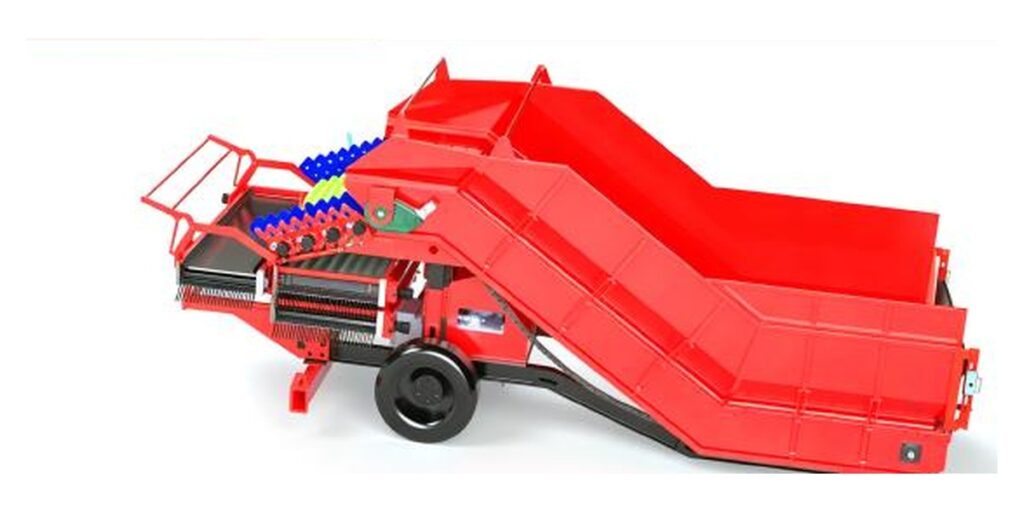
Rated capacities are useful comparison points, not a guaranteed capacity for an assembled line. The effective rate is constrained by the slowest required operation, the quality decision being made, transfer losses and the way good and reject streams are handled. If a receiving cleaner is rated above the inspection stage, increasing the cleaner setting does not increase accepted product flow; it only increases accumulation or sends a larger surge toward the restriction.
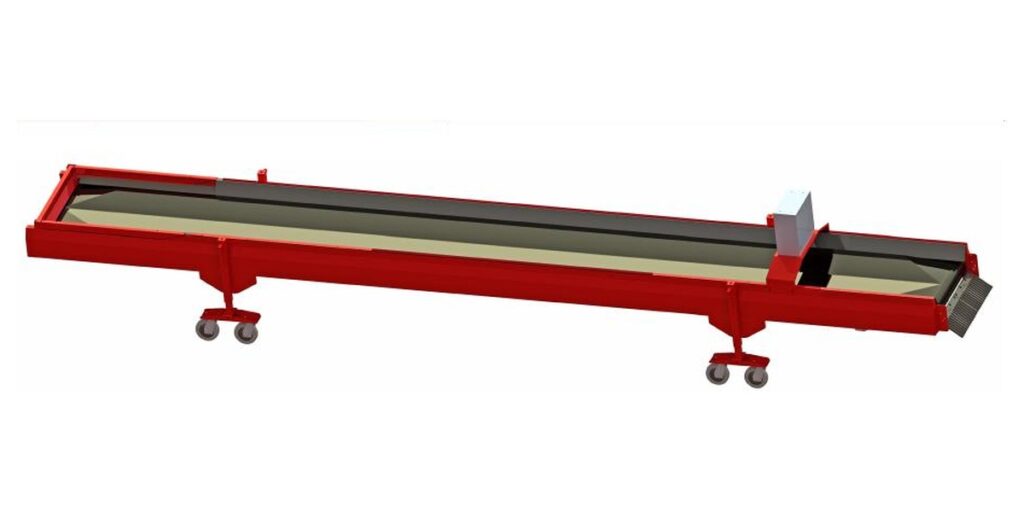
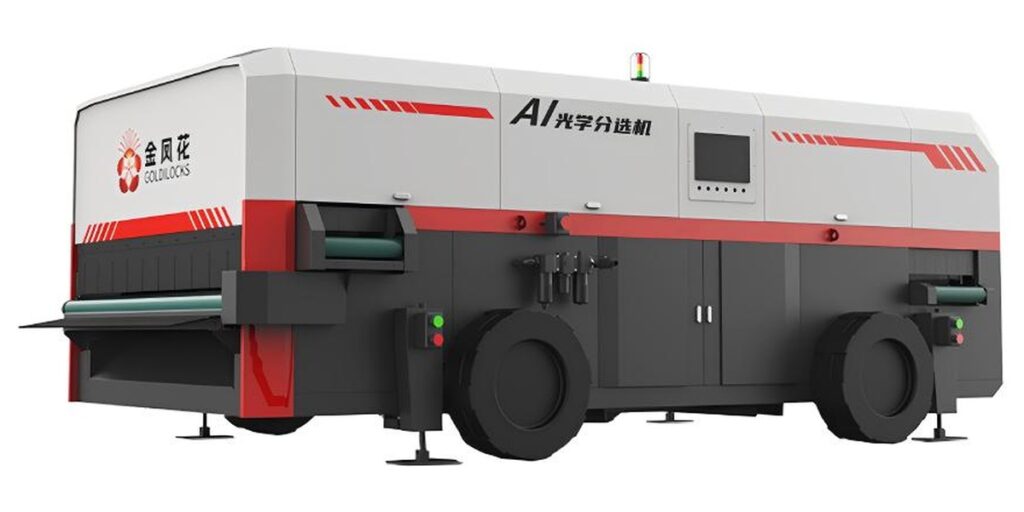
For the selected receiving option, the record states 40 t/h, 60 t/h or >90 t/h for BQX-16, BQX-20 and BQX-24 respectively. The transfer conveyor record states approximately 80 t/h, while CASL-2X-1800 is recorded at 40 t/h. These figures should be read as separate product records. They do not establish the capacity of a connected line, because crop condition, loading pattern, spacing, discharge and reject handling can change the usable rate.
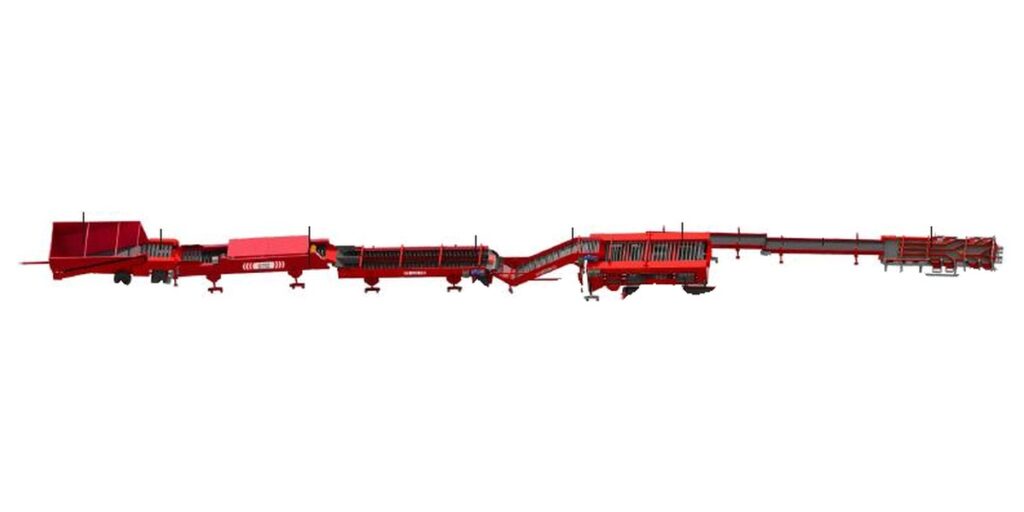
Map each hand-off as a mass balance: incoming mass equals material continuing, material rejected and material temporarily stored, allowing for the measurement interval. A transfer that looks adequate when empty may become the bottleneck when potatoes arrive in a deep or uneven bed. Review the bulk cleaning and impurity-separation equipment, inter-stage conveying equipment and optical sorting equipment as separate duties before deciding where buffering belongs.
| Product | Listed capacity | Listed electrical data | Meaning for this decision |
|---|---|---|---|
| BQX-16 / BQX-20 / BQX-24 | 40 t/h / 60 t/h / >90 t/h | 7.5 kW / 11 kW / 15 kW; AC380V/50Hz | Separate receiving and cleaning ratings; do not treat them as assembled-line capacity. |
| BSSJ8-08 | Approximately 80 t/h | 2.2 kW; AC380V/50Hz | A conveying comparison point; actual hand-off performance still requires a loaded trial. |
| CASL-2X-1800 | 40 t/h | 30 kW; AC380V, three-phase five-wire system | A sorting-stage comparison point; good and reject stream handling must be observed separately. |
Use a transparent buffer calculation
A practical first estimate is based on a rate difference, not on the largest machine rating. For a temporary arrival peak, buffer mass can be estimated as arrival rate minus sustainable process rate, multiplied by the duration of the peak. If the arrival rate is lower than the sustainable rate, the difference is negative and the process is drawing down the queue rather than filling it. This is a planning calculation, not a claim about a built-in buffer or automatic control function.
For example, a hypothetical load arriving at 70 t/h for 12 minutes against a sustainable downstream rate of 40 t/h creates a difference of 30 t/h. The temporary accumulation is 6 tonnes before any recovery period is considered. Once incoming flow stops, a downstream process maintaining 40 t/h removes material from that queue at 40 t/h. Clearing 6 tonnes then takes 9 minutes, provided the outlet remains available and the stated discharge rate is sustained. This calculation excludes interruptions and any material already present before the peak.
Real projects need allowances for uneven loading, crop variation, transfer retention and the fact that a nominal buffer may not be fully usable. Keep the calculation in tonnes and minutes first, then convert it to physical volume only after bulk density, fill level and the actual retaining geometry are defined. Do not use this simple formula to justify a continuous rate above the limiting process or to claim that an unrecorded machine control will maintain it.
- Use the measured peak duration, not the whole shift duration.
- Calculate recovery time after the arrival peak ends.
- State the assumed rates, usable fill level and excluded losses beside the estimate.
Choose the buffer location and operating response
Place temporary storage where it protects the limiting operation without hiding a quality or handling problem. A buffer before cleaning can separate truck timing from the cleaning duty, but it may also hold soil-bearing potatoes longer than intended. A buffer before inspection can smooth cleaned-product delivery, while a buffer after inspection may complicate the separation of accepted and rejected streams. The correct position follows the mass balance and the process requirement, not a general preference for more storage.
Use the simplest operating response that the project can actually support. Operators may reduce upstream feed, pause unloading, divert material to an identified holding point or allow the queue to recover during a planned interval. Do not describe sensors, automatic controls or closed-loop rate matching as part of the arrangement unless those functions are separately specified and verified. A visible level mark, a written response rule and a defined overflow path can be more useful than an assumed control function that has not been tested.
Conveying geometry matters at the decision point. The recorded conveyor has an adjustable height and speed, a detachable feeding baffle, rubber side protection and a finger-shaped buffer. Those stated features support review of transfer presentation, but they do not by themselves prove a particular surge capacity, gentle-handling result or automatic regulation. Confirm the actual transfer condition with loaded potatoes and the intended operating settings.
Make the configuration decision from the limiting rate
Select the receiving, conveying and inspection duties as a coordinated chain, while keeping each product rating separate. If the target is close to the inspection duty, the design priority may be stable presentation and reject-stream clearance rather than a larger receiving unit. If unloading is highly intermittent, the priority may instead be a receiving buffer that protects the downstream process from repeated starts and stops. Neither case can be settled by adding the three rated capacities together.
For each candidate arrangement, prepare a one-page rate sheet with arrival rate, sustainable rate, peak duration, recovery rate, buffer mass, expected good stream and expected reject stream. Include the physical location of the queue, the operator action at the high and low marks, and the condition that stops the trial. This exposes whether the proposed configuration solves a timing problem or merely moves the queue to another transfer.
Use the potato conveying and sorting commissioning checklist to organize the hand-offs, then provide the selected arrangement with the available process solution categories. We can review the rate sheet against the crop sample and site constraints before a final arrangement is defined.
- Do not add individual rated capacities to obtain an assembled-line rate.
- State the limiting operation and the reason it limits flow.
- Define what happens when the buffer reaches its high and low operating marks.
Commission with empty, loaded and recovery trials
Commissioning should progress from an empty run to a controlled material run. During the empty check, verify travel direction, transfer alignment, accessible adjustment points, discharge routing and the ability to stop and restart each relevant section. This establishes that the planned path exists; it does not demonstrate throughput, separation quality or buffer performance.
During the loaded trial, use a known sample and a measured feed interval. Record start and finish times, estimated or weighed input, the good stream, each reject stream, retained material and any visible accumulation. Repeat at a lower rate, the proposed operating rate and a short peak condition. If the crop varies materially in size or contamination, use more than one representative sample rather than averaging unlike conditions into one result.
End with a recovery trial. Stop or reduce the incoming feed while the downstream process continues, then record how long the queue takes to return to the normal operating mark. This distinguishes a buffer that absorbs a burst from one that remains full. Record the settings used, but do not turn a successful short trial into a guarantee for an entire shift without evidence across the required operating window.
- Run empty equipment checks before introducing potatoes.
- Measure input, good output, reject output and retained material over the same interval.
- Repeat the peak and recovery condition with representative crop samples.
Set an acceptance record that explains failure
An acceptance test should define the sample, feed condition, observation period, target rate and stream measurements before production starts. It should also distinguish a capacity shortfall from a presentation problem. For example, a full queue with a clear discharge path may indicate that the downstream duty is limiting; an intermittent empty gap at the inspection inlet may indicate uneven feeding or an incorrectly adjusted transfer.
Use a diagnostic matrix rather than a single pass or fail number. Compare the queue level with good-stream stability, reject clearance and visible carryover. If the line reaches the proposed rate only when reject material is returned to the good stream, the result is not an acceptable demonstration of separated output. If the feed is stable but the queue grows throughout the run, record the sustainable rate below the arrival rate and revise the buffer or schedule.
Acceptance limits must be agreed for the project and supported by the available measurements. The equipment specifications state capacities and functions, but they do not define a complete installed-line acceptance standard, crop-specific accuracy, recovery time or maximum interruption duration. Keep those as project conditions to be agreed and tested, not as assumed product performance.
| Observation | What to record | Likely interpretation | Next engineering action |
|---|---|---|---|
| Queue rises during the peak and falls after unloading stops | Peak duration, highest queue level and recovery time | The buffer is absorbing a temporary rate difference | Check usable capacity and whether recovery completes within the planned interval. |
| Queue remains full while the input continues | Input mass, downstream output and retained mass | Arrival rate exceeds sustainable process flow | Reduce incoming rate, extend buffering or address the limiting operation. |
| Inspection inlet alternates between gaps and surges | Feed timing, transfer setting and queue level | Presentation is unstable even if average rate appears adequate | Review transfer geometry, adjustment and the operating response. |
| Good stream is stable but reject stream accumulates | Good output, reject output and reject discharge time | The separation decision is being made, but reject handling is limiting | Provide a defined reject destination and repeat the rate trial. |
| Measured input does not match good plus reject plus retained material | All streams over the same timed interval | Sampling or weighing boundaries are inconsistent | Repeat the measurement with synchronized start and finish points. |
State the limits before final selection
Buffer sizing is sensitive to information that a nameplate rate cannot provide: arrival timing, crop bulk density, moisture and soil burden, size distribution, acceptable queue height, discharge destinations and the operating window. A calculation based on tonnes per hour can be directionally useful while still being physically wrong if the assumed fill volume, retention time or transfer presentation is not available at the site.
We therefore treat the rate comparison as a selection screen, then verify the limiting hand-off with the intended sample and operating sequence. The final review should include the requested voltage, available footprint, service access, material condition, shift pattern and the exact acceptance record. Product capacities remain qualified with their stated qualifiers; they are not promises for a connected system.
Send the operating brief through our engineering contact page if the peak and sustainable rates are not yet separated. A useful review can begin with unloading records and sample information, then move to a measured trial plan rather than guessing a buffer from the highest number on a specification sheet.
Send the operating data for a buffer and bottleneck review
Use our project engineering contact to send representative crop samples or sample information, unloading mass and duration, target sustainable rate, peak duration, crop size and contamination range, good and reject destinations, site footprint, available voltage, shift pattern and your proposed acceptance measurements.
- BQX-16 / BQX-20 / BQX-24 capacities are 40 t/h / 60 t/h / >90 t/h.
- BSSJ8-08 capacity is approximately 80 t/h.
- CASL-2X-1800 capacity is 40 t/h.
- The listed electrical supply for BQX models and BSSJ8-08 is AC380V/50Hz; CASL-2X-1800 is AC380V, three-phase five-wire system.
Frequently asked questions
Should a potato line be sized for the truck unloading peak?
Not automatically. Separate the short unloading peak from the sustainable rate of cleaning, conveying and inspection. A buffer can absorb a temporary difference only when its usable capacity and recovery period are defined. If the peak is continuous or recovery never occurs, the limiting process must be addressed instead of relying on storage.
Can I add the rated capacities of the machines to obtain line capacity?
No. Individual ratings are comparison points for separate duties. The connected line is limited by the slowest required operation, transfer presentation, crop condition and good or reject discharge. Use a mass balance and a loaded trial to establish the practical operating rate for the proposed arrangement.
Where should a buffer be placed in a potato process?
Place it where it separates the timing problem from the limiting operation without creating a new quality or handling problem. Before cleaning, it may isolate truck timing; before inspection, it may stabilize presentation. The choice depends on soil burden, retention requirements, discharge routing and the measured mass balance.
What should be measured during a buffer acceptance trial?
Measure input mass, good output, each reject stream, retained material, feed rate, peak duration, queue level and recovery time over synchronized intervals. Record equipment settings and crop condition. A trial should include empty checks, controlled loaded operation, a short peak and a recovery period.
What information should I send for a project-specific review?
Send representative crop information, unloading mass and timing, target sustainable rate, peak duration, size and contamination range, good and reject destinations, site footprint, voltage, shift pattern and the proposed acceptance method. These inputs allow the buffer estimate and limiting hand-off to be reviewed together.
Engineering note
Treat the rate calculation as a project planning method and verify it with representative crop samples, synchronized stream measurements and an agreed acceptance interval. Final selection depends on site layout, operating requirements, discharge routing and the limiting hand-off.
 English
 Chinese
 Spanish
 German
 French
 Russian
 Urdu
 Bengali
 Kazakh
 Ukrainian
 Dutch
 Polish