
Calibrate mechanical potato diameter grading by defining the buyer's short-diameter measurement, preparing measured samples on both sides of each cut size, and testing their outlet destinations. Adjust the gap through controlled trials, then repeat at the intended feed rate. Check elongated potatoes and downstream discharge separately: a stated sorting range is not a gap-setting range or a precision guarantee.
Key takeaways
- Define short diameter and exact-boundary treatment before adjusting the grader.
- Test measured samples on both sides of each cut, including elongated shapes.
- Distinguish carryover on the grading surface from downstream discharge mixing.
- Accept repeated outlet counts at the agreed working flow, not a gap setting alone.
Define the Grade Boundary Before Adjusting the Gap
The commissioning problem is straightforward: potatoes close to a buyer’s cut size appear in adjacent outlets, and the operator cannot tell whether the gap, potato shape or feed condition caused the result. Turning an adjustment until one collection looks acceptable can hide the cause. We start by defining the grade boundary in measurable terms, then use identified samples to connect that definition to the mechanical separation.
A diameter grade is not a weight grade. Potatoes with similar short diameters can differ in length, volume and mass, so weighing a sample cannot establish its dimensional class. Write down the buyer’s measurement method, cut sizes, treatment of exact-boundary pieces and allowable cross-grade counts before testing. Where the buyer uses a gauge rather than a caliper, compare those methods on the same potatoes instead of assuming they produce identical classifications.
Why Short Diameter and Orientation Matter
A potato passes through a mechanical opening when its presented cross-section can enter that opening and it has an opportunity to fall. Its longest dimension therefore does not necessarily determine its outlet. An elongated potato may present a narrow cross-section while its length remains much greater. Irregular contours also make a single casual measurement unreliable; use a defined measurement orientation and record unusual shapes separately from regular samples.
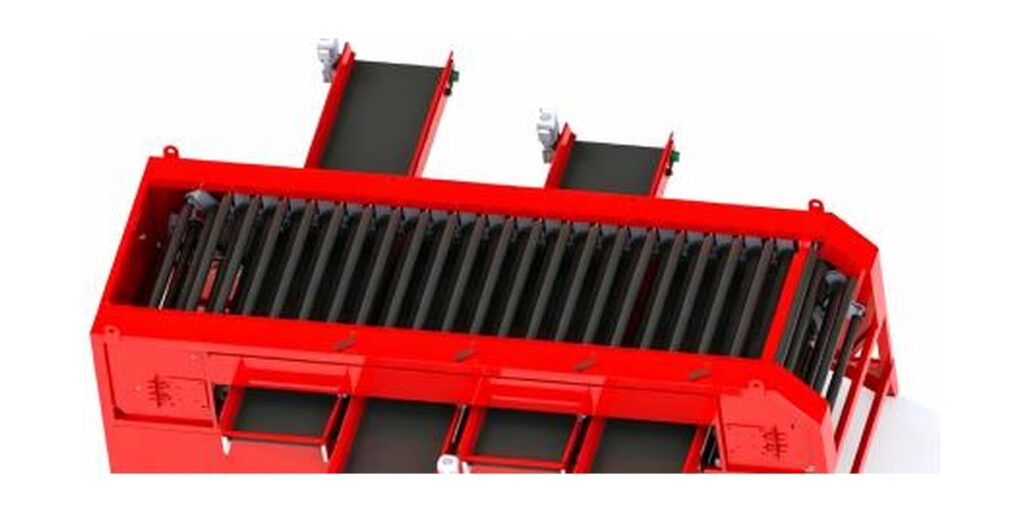
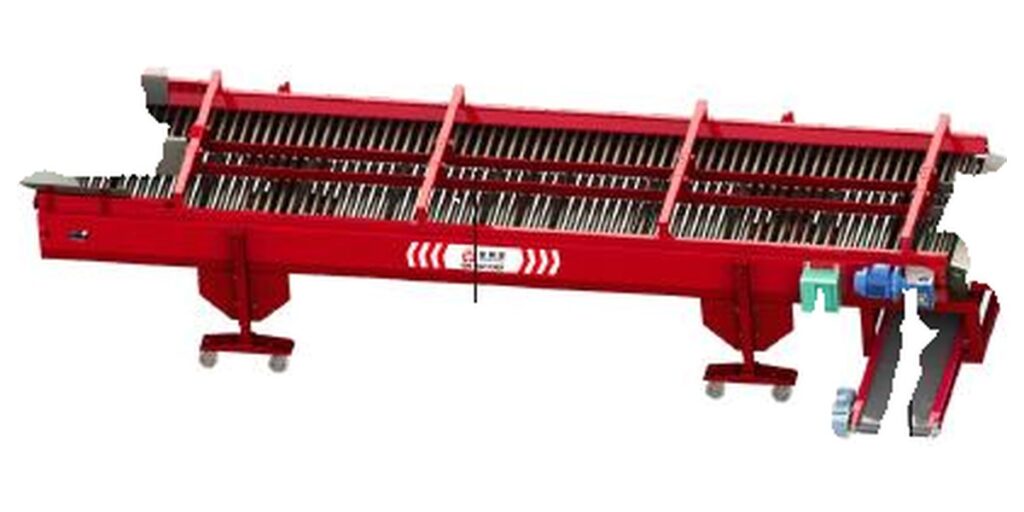
The BF4-14 short-diameter potato grader classifies by short diameter, with adjustable roller gap and discharge direction. Its stainless roller bars rotate 360 degrees, and each discharge belt is individually controlled. These facts describe the mechanism and available controls, not a promised classification tolerance. Rotation can change presentation, but it does not establish that every potato encounters every possible orientation before reaching an outlet.
Choose Outlet Count Around the Required Grades
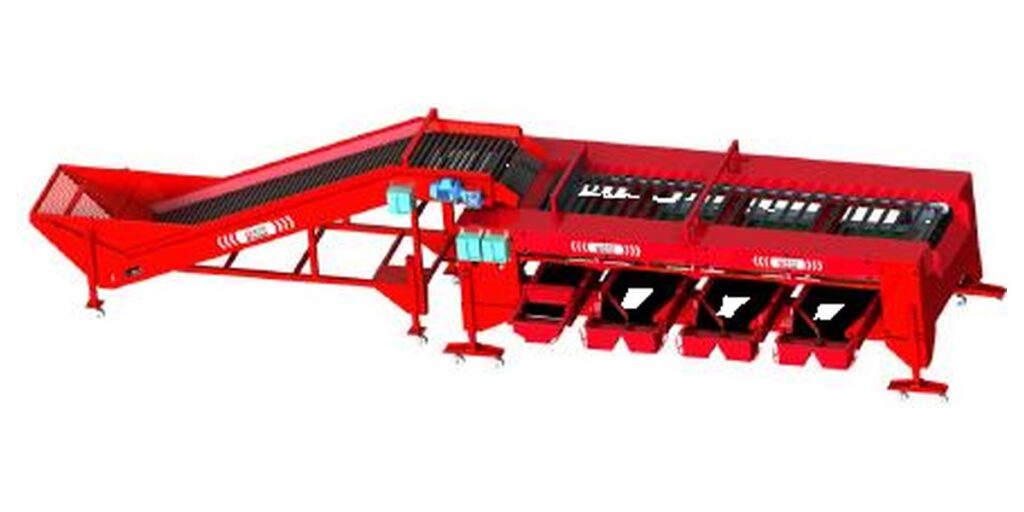
Configuration selection begins with the number of saleable size bands and the disposition of material outside those bands. Three-level and four-level grading are available on the small mechanical potato grader, whose bilateral variable-pitch stainless pipes create an increasing gap along the machine. Different sizes fall to different outlets. Its stated capacity is 3-5 t/h or 8-10 t/h according to configuration; those alternatives should not be treated as one interchangeable operating rating.
Count all required destinations before choosing a configuration, including undersize or oversize where the process needs them. The small-batch potato grading guide provides related selection context. Match the chosen configuration to the requested grade structure and working flow, then establish boundary performance by trial. An extra outlet creates another destination; it does not, by itself, make the separation at any individual boundary sharper.
| Characteristic | BF4-14 | Small mechanical grader | Selection meaning |
|---|---|---|---|
| Separation mechanism | Classifies potatoes by short diameter; adjustable roller gap | Bilateral variable-pitch stainless pipes; gap increases along the machine | Both use mechanical openings; the stated mechanisms differ. |
| Grading levels | Four-level potato grading | Three-level and four-level grading | Choose the stated outlet-level configuration around the required grade structure. |
| Capacity | 60 t/h | 3-5 t/h or 8-10 t/h according to configuration | The smaller machine's capacity depends on configuration. |
| Sorting range | 40-150 mm | No sorting range stated | The stated sorting range is not an adjustable-gap specification. |
| Power and voltage | 4.4 kW; AC380V/50Hz | 1.7 kW (three-level); 2.1 kW (four-level); 220 V | Power differs by grading level on the smaller machine; the stated supplies differ. |
Build Samples on Both Sides of Each Cut
Prepare separate groups clearly below, close below, close above and clearly above each required cut size. The distance from the cut should reflect the buyer’s grading rules and the resolution of the measurement method, not an invented machine tolerance. Include elongated and irregular potatoes in identifiable groups. A sample containing only obvious small and large pieces can show that separation occurs while revealing little about the boundary that matters commercially.
Record each sample’s measured short diameter, shape category and intended destination. Use identification that remains readable without materially changing passage through the grader, or run traceable groups separately. Keep ordinary crop samples as well: selected boundary pieces diagnose the separation, while a representative lot shows how often that difficult condition occurs. State sample counts in advance and retain the same reference groups for repeated trials where their condition remains suitable.
Calibrate One Boundary With Controlled Trials
Begin with an isolated boundary group under a controlled feed condition that lets you observe passage. Record the starting adjustment position and the observed destination of every test piece. Change one relevant setting at a time, then repeat the same comparison. The aim is to establish how the observed separation responds to adjustment, not to assume that a nominal opening equals the buyer’s cut size under every orientation and loading condition.
Inspect the opening at accessible positions using a consistent method and the applicable machine procedure; isolate moving equipment before physical measurement. Treat any position-to-position difference as a diagnostic observation rather than assigning an unsupported tolerance. The stated 40-150 mm sorting range belongs to the larger grader’s application specification. It is not a stated adjustable-gap range, a list of available cut settings or evidence of sizing precision.
Separate Carryover From Discharge Mixing
A potato that reaches a later outlet may have travelled over an opening without falling through it. This carryover is different from a potato that entered the intended outlet but was collected in the wrong stream downstream. Crowding, contact between potatoes and orientation can influence the opportunity to pass through an opening. Observe where the sample first leaves the grading surface before deciding that the gap needs another adjustment.
Check outlet identity, collection boundaries and the complete route to the receiving container. On equipment with individually controlled discharge belts, include their operating state in the trial record. Compare controlled-feed results with results at the intended production feed rate to expose loading effects. Use our potato handling and grading solutions to discuss the surrounding process, but keep the mechanical boundary test distinct from the downstream collection check.
| Observed result | Comparison to make | Possible explanation | Next check |
|---|---|---|---|
| Near-cut samples divide between adjacent outlets | Compare measured groups immediately below and above the cut | Boundary position or orientation sensitivity | Repeat unchanged, then test one adjustment with the same groups. |
| Elongated samples differ from regular samples | Compare groups with similar measured short diameters | Shape-dependent presentation | Observe passage and report shape groups separately. |
| More small samples reach later outlets at higher feed | Compare controlled feed with the agreed working flow | Loading-dependent carryover | Observe contact and opportunities to fall before adjusting the boundary. |
| Correct initial outlet but wrong collection container | Trace the sample from grading surface to collection | Discharge routing or stream mixing | Check outlet labels, receiving positions and discharge operation. |
| Unchanged settings give inconsistent counts | Compare measurement, sample identity and feed condition | Test-method variation or unstable presentation | Standardize the trial conditions and repeat before further adjustment. |
Accept the Boundary Through Repeated Outlet Counts
Create an outlet-count record for each measured input group: intended outlet, actual outlet and any unaccounted sample. Calculate the fraction assigned to each destination using a stated denominator. Report below-cut pieces entering the above-cut stream separately from above-cut pieces entering the below-cut stream. Combining those errors into one number can conceal a commercially important imbalance, particularly when the buyer places different consequences on undersize and oversize material.
Repeat the trial without changing settings, then repeat with a representative crop lot at the agreed working flow. Keep sample composition, measurement method and collection procedure consistent so results are comparable. Set acceptance limits jointly before the test; the equipment specifications do not establish a sizing-accuracy guarantee. Record the configuration, adjustment positions, feed condition, outlet routing and test counts so a later operator can reproduce the evaluated operating condition.
Recheck When Crop Shape or Operating Conditions Change
A successful trial establishes performance for the tested crop and operating conditions, not every future lot. Recheck reference groups when the shape distribution changes, after relevant adjustment or maintenance, or when outlet counts shift unexpectedly. If repeated runs disagree, examine measurement consistency, sample condition, feed loading and discharge collection before making successive gap changes. Otherwise, each adjustment may compensate for a different cause and leave no stable reference setting.
Mechanical diameter grading also does not establish weight class or visual quality. Buyers needing additional selection criteria should define them separately; the comparison of optical potato sorting and roller inspection discusses that distinction. For diameter grading, the useful handover is a documented boundary-sample method and outlet result, with its limitations stated, rather than a dial position presented as a universal guarantee.
Arrange a Boundary-Sample Grading Trial
Discuss potato diameter grading and a boundary-sample trial with our engineering team. Send representative crop samples, elongated examples, the buyer’s diameter measurement method, required cut sizes and grade destinations, target hourly flow, available footprint, electrical supply and discharge arrangement. Include proposed sample counts and allowable cross-grade limits so we can define the trial and acceptance record together.
- BF4-14 classifies potatoes by short diameter.
- BF4-14: Four-level potato grading; sorting range 40-150 mm.
- Small mechanical grader capacity: 3-5 t/h or 8-10 t/h according to configuration.
- Small mechanical grader power: 1.7 kW (three-level); 2.1 kW (four-level).
Frequently asked questions
Does the 40-150 mm sorting range tell me which roller gaps I can set?
No. The equipment specification states a 40-150 mm sorting range for the short-diameter grader, not an adjustable-gap range. It does not establish gap increments or sizing precision. Evaluate your required cut sizes with measured boundary samples and agree on acceptance limits before treating a setting as suitable for production.
Can I use potato weight to check a diameter grade?
Weight alone cannot verify a diameter grade because potatoes with similar short diameters can have different lengths and masses. Use the buyer's defined dimensional measurement or gauge method to classify the trial samples. Record weight separately only where it serves an additional purchasing or packing requirement.
Why do elongated potatoes sometimes enter a different outlet?
Passage depends on the cross-section presented to the opening, not simply the potato's overall length. An elongated potato can present a narrow section, while contact or orientation may delay passage. Test elongated pieces as a separate, measured group and observe where they leave the grading surface before changing the gap.
Should I test at low feed or the intended production rate?
Use both for different purposes. A controlled feed makes individual passage easier to observe and helps isolate the boundary response. A trial at the intended working flow checks whether loading changes the result. Record the feed condition for each run and do not use a controlled-feed result alone as production acceptance.
What should the diameter-grading acceptance record include?
Include the buyer's measurement method, cut sizes, sample counts, shape groups, configuration, adjustment positions, feed condition and outlet routing. Record actual destinations and unaccounted samples, with below-cut and above-cut errors reported separately. Repeat unchanged trials and apply acceptance limits agreed for the project rather than assuming an unstated machine accuracy.
Engineering note
Mechanical grading results depend on crop shape, the dimensional measurement method, feed condition and discharge collection. Project acceptance should use agreed boundary samples and repeated outlet counts under the intended operating conditions; no numerical sizing tolerance is specified here.
 English
 Chinese
 Spanish
 German
 French
 Russian
 Urdu
 Bengali
 Kazakh
 Ukrainian
 Dutch
 Polish